

Palm olein is the liquid part of palm oil. It is separated from palm oil by cooling the oil until its harder fats crystallise, then filtering those crystals out. Indian food regulations write it as one word, palmolein.
Palm oil, palm olein and super olein all come from the same fruit, but they behave differently in a fryer and in a storeroom. This article explains how each one is made, how to tell them apart on a specification sheet, and how to choose between them, and between palm olein and sunflower oil, for frying. It starts with what palm olein actually is.
What is palm olein?
Palm olein is the liquid fraction of palm oil, obtained by fractionation, which means separating an oil into parts that melt at different temperatures. The refined grade sold for cooking and frying is usually labelled RBD palm olein, or refined palmolein.
The international food standard defines palm olein as the liquid fraction derived from the fractionation of palm oil, and Indian regulations use the same definition for palmolein. Palm oil itself is pressed from the fleshy outer layer of the oil palm fruit. The seed inside the fruit gives a different oil, palm kernel oil, which belongs to the lauric family of fats and behaves very differently.
RBD stands for refined, bleached and deodorised, the three processing steps that take out impurities, colour and smell before the oil is sold for food.
To see why the liquid part of palm oil behaves so differently from the whole oil, it helps to look at how the two are separated.
How is palm olein made?
Palm olein is made by dry fractionation: refined palm oil is warmed until it is fully liquid, then cooled slowly under control so that its higher-melting fats form crystals. The mixture is pressed through a filter, the liquid that passes through is palm olein, and the solid left behind is palm stearin.
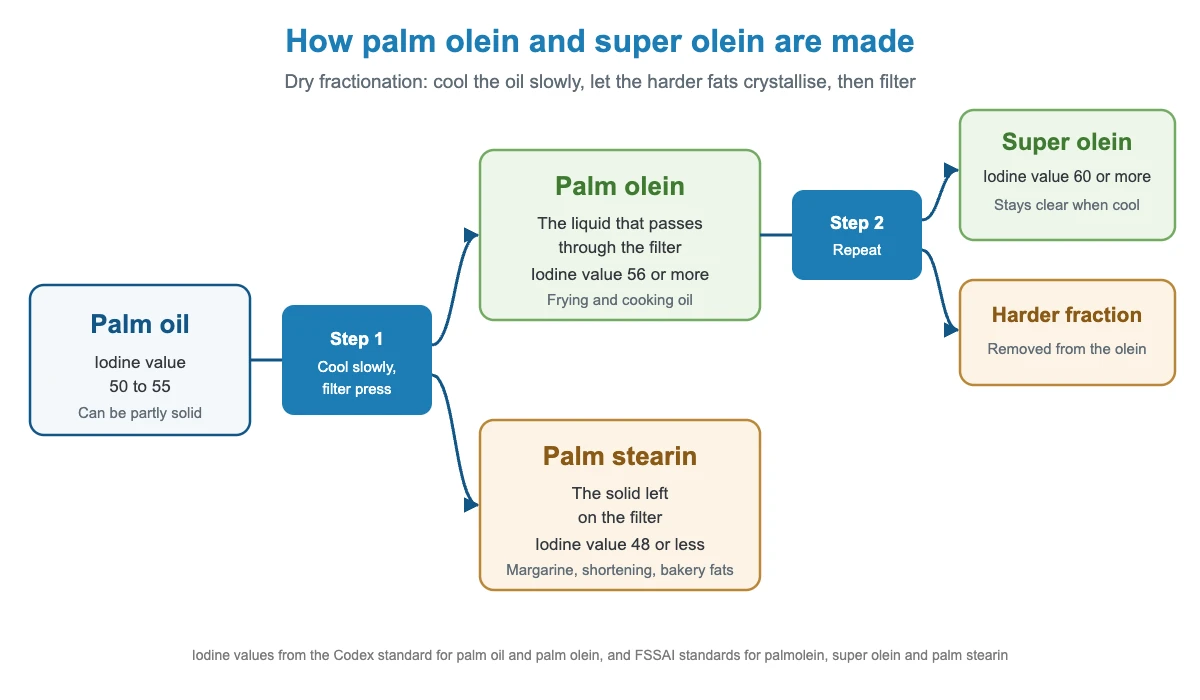
In a typical plant, the oil is cooled in slowly stirred, water-cooled vessels and separated in a filter press. The cooling rate is set by controlling the temperature of the water around the oil.
Both fractions are useful. Palm olein goes mainly into frying and cooking oil, while palm stearin, the solid fraction, goes into margarine, shortening and bakery fats.
Removing the stearin changes the oil in ways that show up on a specification sheet, and that is where the difference between palm oil and palm olein becomes clear.
What is the difference between palm oil and palm olein?
Palm oil is the whole oil and can be partly solid at room temperature, while palm olein is the liquid portion left once the harder fats have been removed. Because those harder fats are gone, palm olein contains less palmitic acid, more oleic acid and has a higher iodine value than the palm oil it came from.
Palmitic acid is a saturated fatty acid with sixteen carbon atoms. Saturated means it has no double bonds in its carbon chain, and fats rich in it are firm. Oleic acid has eighteen carbon atoms and one double bond, and fats rich in it stay liquid. The international standard puts palmitic acid at 39.3% to 47.5% of palm oil but 38.0% to 43.5% of palm olein, with oleic acid rising from 36.0% to 44.0% in palm oil to 39.8% to 46.0% in palm olein.
The iodine value sums this up in one figure. It measures how many double bonds an oil contains, so a higher iodine value means a more unsaturated, more liquid oil. Palm oil sits at 50 to 55, and palm olein at 56 or more. Indian regulations set a range of 54 to 62 for palmolein.
The melting behaviour follows the same pattern. Slip melting point is the temperature at which a solidified fat softens enough to start to flow. Indian standards allow palm oil a slip melting point of up to 39°C, while the international standard sets no more than 24°C for palm olein.
Repeat the fractionation and the gap widens again, which is what produces super olein.
What is super olein, and how is it different from palm olein?
Super olein is palm olein that has been fractionated a second time, which removes more of the fats that crystallise when the oil gets cold. It has a higher iodine value, at least 60 under Indian standards, and stays clear at lower temperatures than standard palm olein.
The Malaysian Palm Oil Board describes super olein as olein from a second fractionation, with a higher iodine value and therefore a lower cloud point. Indian regulations set its iodine value at not less than 60.
Cloud point is the temperature at which an oil starts to turn hazy as its first crystals form. Indian standards allow standard palmolein a cloud point of up to 18°C, while super olein grades are commonly traded to stay clear down to about 5°C.
That difference matters wherever the oil is stored or seen. Standard palm olein can turn cloudy in cold weather, and even on an air-conditioned supermarket shelf, while super olein clouds only at much lower temperatures. The haze is crystallised fat and clears when the oil is warmed, but a cloudy bottle or tin still looks wrong to a customer.
The table below sets the four palm products side by side.
| Product | How it is obtained | Iodine value | At room temperature | Typical uses |
|---|---|---|---|---|
| Palm oil | Pressed from the flesh of the oil palm fruit | 50 to 55 | Can be partly solid | Starting material for olein and stearin |
| Palm olein | Liquid fraction after one fractionation | 56 or more (54 to 62 in India) | Liquid, may cloud in cool weather | Frying and cooking oil |
| Super olein | Liquid fraction after a second fractionation | 60 or more | Liquid, stays clear at lower temperatures | Frying and liquid oil where cool storage would cloud standard olein |
| Palm stearin | Solid fraction left on the filter | 48 or less | Solid | Margarine, shortening and bakery fats |
The iodine values come from the Codex standard for palm oil and palm olein, and from Indian regulations for palmolein, super olein and palm stearin.
For frying, the most important property is not in the table: how well the oil holds up after hours at frying temperature.
Why is palm olein used for frying?
Palm olein is used for frying because it is highly resistant to oxidation, so it lasts longer in the fryer before it has to be discarded. A review of frying research found that palm oil and its products, mainly palm olein, perform on a par with high-oleic oils, which are seed oils from varieties bred for a higher oleic acid content.
The same review describes palm olein as one of the most important frying oils, valued for its high oxidative stability and for the quality of the food it produces. Oxidative stability is an oil’s resistance to reacting with oxygen in the air, which is one of the main ways frying oil breaks down and develops off-flavours.
The reason lies in its fatty acid make-up. Linoleic acid is a fatty acid with eighteen carbon atoms and two double bonds, and in air it oxidises about 27 times faster than oleic acid. Palm olein contains 10.0% to 13.5% linoleic acid, while standard sunflower oil contains 48.3% to 74.0%. Earlier studies, cited by researchers comparing the two oils, put palm oil’s lower tendency to degrade down to its fatty acid composition.
Sunflower oil is the comparison most buyers make, so it is worth looking at what happens when the two are used side by side.
Palm olein vs sunflower oil: which lasts longer in the fryer?
In two published frying studies, palm olein and palm oil both held up better than sunflower oil. In the first, a study of repeated potato frying, the acid value of sunflower oil rose by 50.0% over 7 days, against 26.8% for palm olein.
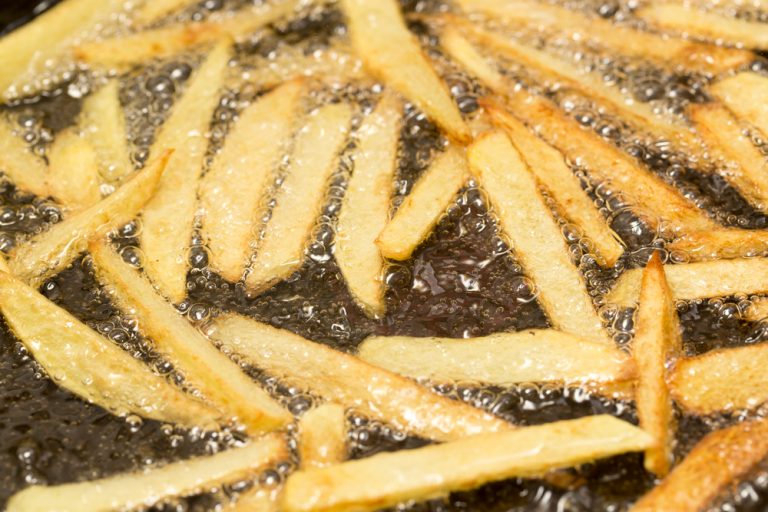
Acid value measures the free fatty acids in an oil, which are fatty acids that break away as the oil degrades, and a rising figure is one of the first signs that frying oil is wearing out. In that study, each oil was heated for 40 minutes a day at 165°C for 7 days. The two oils showed a similar rise in peroxide value, a measure of early oxidation, and the authors concluded that palm olein was the more suitable frying oil, while noting that only two quality measures had been tested.
The second study fried potato slices in repeated 15-minute cycles over 12 hours at about 175°C and found that sunflower oil degraded fastest of the three oils tested, which were coconut, sunflower and palm oil. That study used palm oil rather than palm olein, but it points the same way.
Sunflower oil’s strength lies elsewhere. With an iodine value of 118 to 141, it is far more unsaturated than palm olein, which is why it stays liquid in cold weather and also why it breaks down faster under heat.
Which oil suits a given kitchen or line depends on more than the chemistry, though.
How do you choose a frying oil for commercial use?
Choose a frying oil by how long it stays in the fryer, where it will be stored and what the finished product needs, then confirm the grade on the specification sheet. For long or continuous frying, palm olein or super olein will usually outlast sunflower oil, and where the oil is stored or displayed in the cold, super olein clouds at a much lower temperature than standard olein.
Four questions settle most decisions:
- How long is the oil in use? Continuous fryers and kitchens that fry for hours need an oil that resists breaking down. This is where palm olein earns its place.
- Where will the oil be stored and seen? In cold storage, in cooler months, or on an air-conditioned shelf, standard palm olein can cloud. Super olein stays clear to a much lower temperature, though in a very cold store even super olein will cloud.
- How much do you fry each day? Food businesses in India that use more than 50 litres of oil a day for frying must keep records of oil used, discarded and disposed of, a rule enforced from 3 March 2019. Oil whose total polar compounds exceed 25% must not be used. Total polar compounds are the breakdown products that build up as oil is reused, and they are the standard measure of when frying oil is spent. An oil that breaks down more slowly reaches that limit later.
- What do you check on the specification sheet? The iodine value should sit in the range for the grade you ordered, and for olein the cloud point should suit your storage. Free fatty acid and peroxide value show how fresh the oil is on arrival.
Ask for a certificate of analysis with every delivery, not only the first. Comparing certificates over several deliveries is the simplest way to see whether a supplier’s oil stays consistent.
Those are the questions we ask buyers before recommending an oil, and they map directly onto what we make.
Which palm olein and super olein does 3F supply?
We make refined palm olein and refined palm super olein, sold under the Palmdelite and Ezyfry names. Our Krishnapatnam site has a refinery and a dry fractionation plant, the process described earlier in this article.
3F Industries Limited was founded in 1960 and makes fats, oils and oleochemicals at four plants. Our palm olein range on the edible oils page includes:
- Palmdelite. Refined palmolein, in 500 ml and 1 litre packs and in 15 kg and 15 litre tins.
- Ezyfry. Our frying oil, made in two grades: refined palm olein, and refined palm super olein for conditions where standard olein would cloud. Both come in 15 kg and 15 litre tins. We make Ezyfry for low oil absorption and a small fall in iodine value during frying, which is a sign that the oil is breaking down slowly.
For larger users, we supply packed oils and fats in bulk by road tanker. We have been a member of the Roundtable on Sustainable Palm Oil (RSPO), the main global standard for sustainable palm oil, since 2014.
Common questions
Is palmolein the same as palm oil?
No. Palmolein is the liquid fraction separated from palm oil by fractionation. It has a higher iodine value than palm oil and stays liquid at temperatures where palm oil starts to set.
Is palm olein the same as palm kernel olein?
No. Palm kernel olein comes from palm kernel oil, which is pressed from the seed of the palm fruit rather than its flesh. Its iodine value is at least 21, against 56 or more for palm olein, and it belongs to the lauric family of fats.
Why does palm olein turn cloudy in winter?
Some of its fats crystallise as the temperature falls, and those crystals make the oil look hazy. Warming clears it. If your oil is stored or displayed in the cold, super olein stays clear to a lower temperature.
Tell us how you fry and we will recommend the oil
Send us what you fry, how many hours a day the oil is in use, how much you use each day, where the oil is stored and how you need it packed. Our team will come back with the grade that fits.